Transparency and Sustainability
Where markets and politics lead to long term damage

Recently I reflected on "When a system is sustainable" and argued that balancing inputs and outputs is key to achieve anything close to a sustainable ecosystem. I want to explore that thought a bit more today because if it was that simple we'd be much closer to a solution already. So what's the rub?
When thinking about what needs to happen to balance inputs and outputs, there's three aspects to the problem. First, in order to balance inputs and outputs, one needs to quantify the parameters. Second, the information needs to be disseminated along the process. And third, the valuation of the output needs to reflect that information.
Water is a perfect example to illustrate why this is difficult in the case of common goods and long term risks. An analysis by Ecolab shows nicely that the prices of water are inversely correlated to the availability, and hence the risk of water shortage. While (drinking-)water in Amsterdam (where it is readily available) is priced at $ 3.42 per unit (Ecolab unfortunately doesn't specify what unit they use in this comparison) it costs $ 0.59 in Beijing, a region severely impacted by water scarcity.
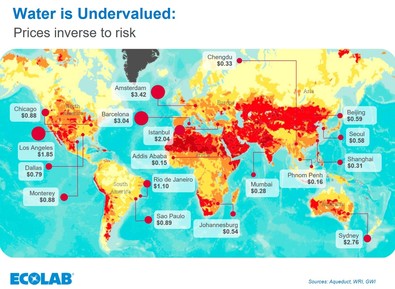
That is a problem because the chain to achieve a balanced system (quantify, disseminate & reflect information) is broken at the very beginning. There is little interest for parties to quantify the use of common goods as input factors. Using water is almost free in many places (and particularly places with scarcity) and hence it doesn't make sense for a production company to monitor water usage.
But why is it so difficult to price water correctly? That's where the long term perspective comes in. While markets are efficient in aligning supply & demand for goods under normal circumstances, they tend to fail in cases of goods for which supply is not very transparent and risks are far in the future. Again, water is a great example because for each market participant the supply looks abundant. However, on an aggregated basis it is not. The problem is that water sources are dispersed all over the world and it is difficult to have an up-to-date picture of the actual supply and demand. A shortage in water on a global basis will therefore only impact the individual consumer in the long run (except obviously those directly affected by drought, but those tend to minimize their usage already because of their awareness of the problem).
Initiatives like the one of Ecolab and Trucost are therefore needed to provide better information to market participants what the risks and costs associated with water usage are. Unfortunately, policies to provide easy access to freshwater for companies in many countries further distort markets and lead to those businesses not having economic incentives to start reducing, reusing, and recycling water.
